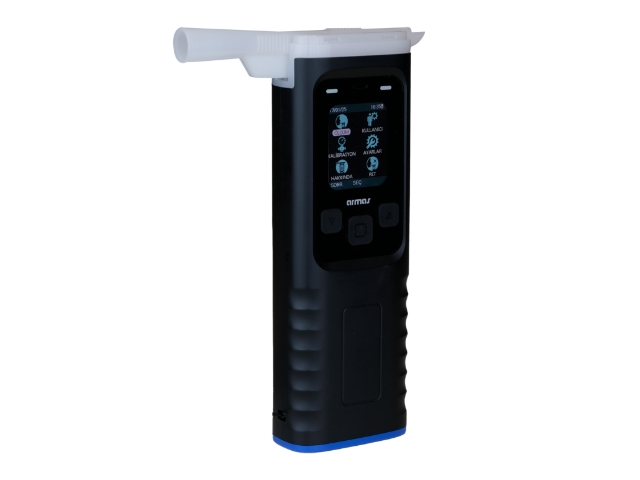
A police breathalyzer is a breath alcohol testing device whose result can be documented and relied upon in an official proceeding. In procurement documents and technical standards the same device class is usually described as an evidential breath alcohol tester, and that is the term buyers should look for when writing a specification.
This guide explains what separates a law enforcement device from a personal screening unit, how roadside testing is typically structured, and which criteria matter when a public authority or fleet operator is preparing a tender.
What Is a Police Breathalyzer?
Devices used in roadside enforcement belong to a different class from consumer breathalyzers. The distinction is not in the housing or the display but in how the result is recorded and how it can be traced afterwards.
For a result to support an official action, it must remain verifiable after the roadside check is over. Evidential devices therefore do more than display a value: they produce an output that carries the date, the time and the device identity, so that the record can be reviewed later. Personal devices are built for self-information and carry no such documentation chain.
This is why the first question in any procurement process is not about the device at all. It is about the result: where will it be used? If the outcome supports an administrative or judicial process, an evidential class device is required. If the purpose is internal screening or awareness, other classes may be appropriate. We examine that boundary in detail in our guide to evidence class breathalyzer features and differences.
How Roadside Alcohol Testing Is Carried Out
Enforcement operations generally follow a two-stage structure. The first stage is a rapid screening pass, designed to assess a high volume of drivers without holding up traffic. Where the screening indicates that a closer assessment is warranted, the officer moves to a second stage using a device capable of producing a documented result.
The result from the second stage is recorded together with the device output and entered into the official report. Structuring the process this way keeps checkpoints moving while ensuring that whatever supports a formal action is properly captured.
Contact-free devices have become common at the screening stage, particularly at high-volume checkpoints and border crossings, because they allow an initial assessment without a mouthpiece for every driver. We cover the operating logic of that device class in non-contact measuring breathalyzers.
Legal Limits and What They Mean for Procurement
Blood alcohol limits are set by national legislation and differ considerably between jurisdictions. Many countries also apply a lower threshold to commercial, professional and public service drivers than to private motorists. Because of this variation, a device specification cannot be separated from the legal framework it will operate under.
Türkiye, where our devices are manufactured, illustrates the pattern. Under Article 48 of Highway Traffic Law No. 2918, the limit is 0.50 per mille for private car drivers and 0.20 per mille for other drivers, a category that covers commercial transport, buses, minibuses, taxis and trucks. Exceeding the limit results in an administrative fine, immobilisation of the vehicle and withdrawal of the driving licence for six months, two years or five years depending on how many times the offence has been repeated. Above a certain level the matter moves beyond administrative sanction into criminal proceedings under Article 179/3 of the Turkish Penal Code.
For an international buyer the relevant lesson is procedural rather than numerical. Two questions shape the specification: what threshold does national law define for each driver category, and what does that law require before a breath test result can be used in an official proceeding? The answers determine the device class, the documentation output and the calibration regime the tender must call for.
Note: the information above is general in nature. Legislation changes, and the current provisions applicable in your jurisdiction should be confirmed against official sources before they are written into a specification.
Evidential Versus Personal Breathalyzers
The dividing line between the two classes is traceability. On an evidential device the record created after a test is retained together with the date, time, device identity and, where required, the operator. That record is what allows a result to be reviewed or challenged later.
Personal devices serve a different purpose: giving an individual a sense of their own condition. Their output does not support a formal proceeding, and presenting it as though it does is incorrect.
Calibration management is the second dividing line. In enforcement use the calibration schedule is run as an institutional process and the calibration status of each device is documented. Our evidential models are listed under law enforcement professional breathalyzers.
Features Required in Law Enforcement Breathalyzers
Field conditions place demands on a device that consumer use never does. The capabilities that matter most in enforcement deployment are:
- Printed output: integrated or portable printer support so the result can be documented at the roadside
- Camera and image capture: visual record of the test as it is carried out
- Onboard memory and data transfer: retention of test records on the device and transfer to a central system
- Calibration tracking: visibility of when each device is next due for calibration
- Field durability: suitability for outdoor use, variable weather and long shifts
- Consumable continuity: uninterrupted supply of single-use mouthpieces and accessories over the service life of the fleet
Printer and camera configurations are widely specified at high-volume checkpoints because they shorten the reporting step. In-vehicle and fleet applications call for a different device family altogether, which we address in vehicle breathalyzers: usage areas and selection criteria.
Procurement Considerations for Authorities and Fleet Operators
In institutional purchasing the device specification is only part of the decision. The headings that shape a successful tender are:
- Clear definition of the deployment scenario and the required device class
- Specifications written around function and documentation rather than brand names
- Clarity on who performs calibration and periodic maintenance, and on what cycle
- Continuity of consumable supply across the service life of the fleet
- Scope of operator training and after-sales technical support
- For import, the export documentation and certification the destination market requires
ARMAS Elektronik is a manufacturer of breath alcohol testing devices and emergency vehicle warning systems, not a reseller. Our institutional reference base includes public authorities and law enforcement organisations, and our vehicle manufacturer partnerships cover OEM programmes. Because production is in-house, calibration, spare parts and technical support are managed directly by us rather than passed along a supply chain, which is the point at which multi-year public deployments most often run into difficulty.
The full procurement process is set out step by step in our institutional breathalyzer procurement guide. The complete product family is listed under breath alcohol testers, and our export team can be reached through the contact page for quotations, distribution enquiries and OEM partnerships.
Frequently Asked Questions
Is a police breathalyzer the same as a personal breathalyzer?
No. Devices used in enforcement are evidential class units on which the result is recorded together with the date, time and device identity. Personal devices are intended for self-information and do not support an official proceeding.
What is an evidential breath alcohol tester?
It is a device class whose output can be documented and traced after the test, so that the result remains reviewable. This is the term normally used in tender documents and technical specifications rather than the informal phrase police breathalyzer.
Do legal alcohol limits differ between countries?
Yes. Limits are defined by national legislation and vary between jurisdictions, and many countries apply a stricter threshold to commercial and professional drivers. The provisions applicable in your market should be confirmed against official sources.
Why does calibration matter in enforcement use?
Calibration demonstrates that a device continues to operate within the conditions defined by its manufacturer. In enforcement deployment the calibration schedule is managed as an institutional process and the status of each device is documented.
What is the difference between printer and camera configurations?
Printer models produce the result as a printed output at the roadside. Camera configurations additionally capture the test as a visual record. The choice follows the reporting and archiving process of the organisation.
Do you supply public tenders and export markets?
Yes. As a manufacturer we supply institutional and public sector projects and work with distributors and OEM partners in export markets. Share your deployment scenario, unit volumes and documentation requirements and our export team will prepare a suitable configuration.